

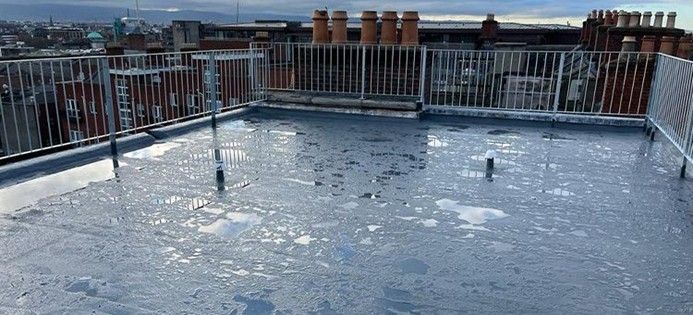
Here is why shifting your specification to PMMA (Polymethyl Methacrylate) cold liquid applied systems can keep your project moving, even when the thermometer hits freezing.
The "cold" advantage
The primary failure point for PU (Polyurethane) systems in winter is the cure mechanism. Most require ambient heat to activate. If it’s too cold, they stay tacky, trapping moisture and leading to early failure. Triflex PMMA technology utilises a rapid chemical cross-linking process that neither temperature or atmospheric humidity affects the curing process.
- The result: Our systems can be applied effectively at winter temperatures, curing at 0°C and -5°C at the details
- The benefit: You gain months of operational time (November - March) that are typically written off by other manufacturers
Speed is safety
In the UK climate, a dry substrate at 10:00 AM can be rained on by 11:00 AM. Specifying slow-curing systems creates a massive window of risk where the membrane is vulnerable to wash-off or pitting.
Triflex systems are designed for rapid cure:
- Rainproof: In approximately 30 minutes
- Walkable: In roughly 45-60 minutes
For a Facilities Manager overseeing a car park or a hospital roof, this means a contractor can prep, prime, and install a fully watertight system between weather fronts, drastically reducing the risk of water ingress during works.
Eliminating the "Hot Works" risk
Winter often brings the temptation to use heat to dry out substrates or apply torch-on felts. However, the NFRC (National Federation of Roofing Contractors) has highlighted the immense insurance risks associated with hot works, particularly on refurbishment projects with combustible timber decks or existing insulation.
Triflex is totally cold applied. There are no gas torches, no naked flames, and no heating of bitumen. This simplifies compliance with the Joint Code of Practice for Fire Prevention on Construction Sites, lowers insurance premiums, and makes it the default choice for safety-critical environments like schools and hospitals.
Tough enough for the toughest season
Winter isn't just cold; it's abrasive. Grit salts, freeze-thaw cycles, and snow ploughs on car park decks wreak havoc on brittle surfaces. Because Triflex systems are fully reinforced and chemically bonded to the substrate, they offer:
- Dynamic crack bridging: The elastomeric material stays flexible even in sub-zero temperatures, accommodating the movement
- Hydrolysis resistance: Unlike some systems that degrade when left in ponding water, Triflex PMMA is unaffected by standing water - crucial for flat roofs that may not drain perfectly during heavy winter storms
Don't let the calendar dictate the schedule
Specifying a waterproofing system is about managing risk. By choosing a system limited by temperature, you introduce the risk of delays, cost overruns, and application failure.
By specifying Triflex, you are effectively specifying certainty. You are ensuring that whether the project starts in July or January, the performance, cure time, and warranty remain exactly the same.